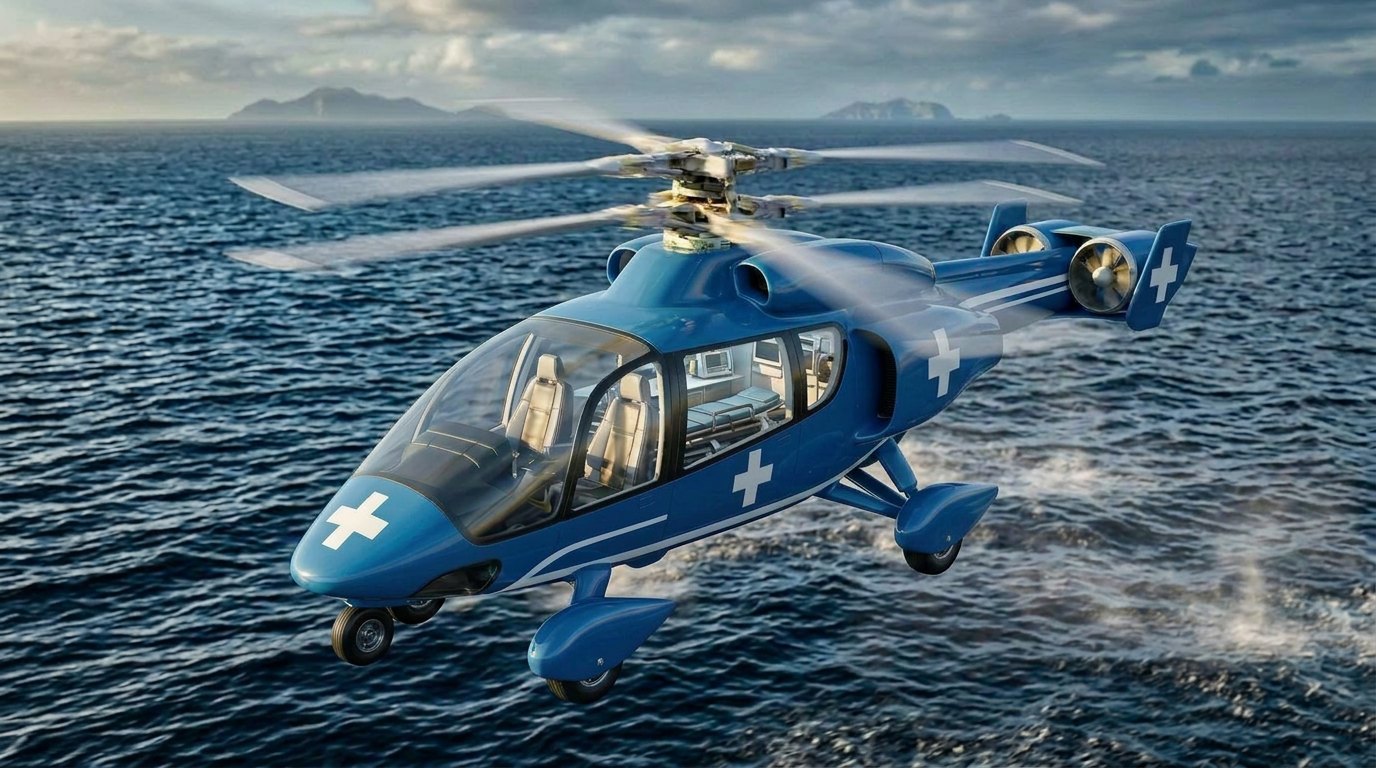
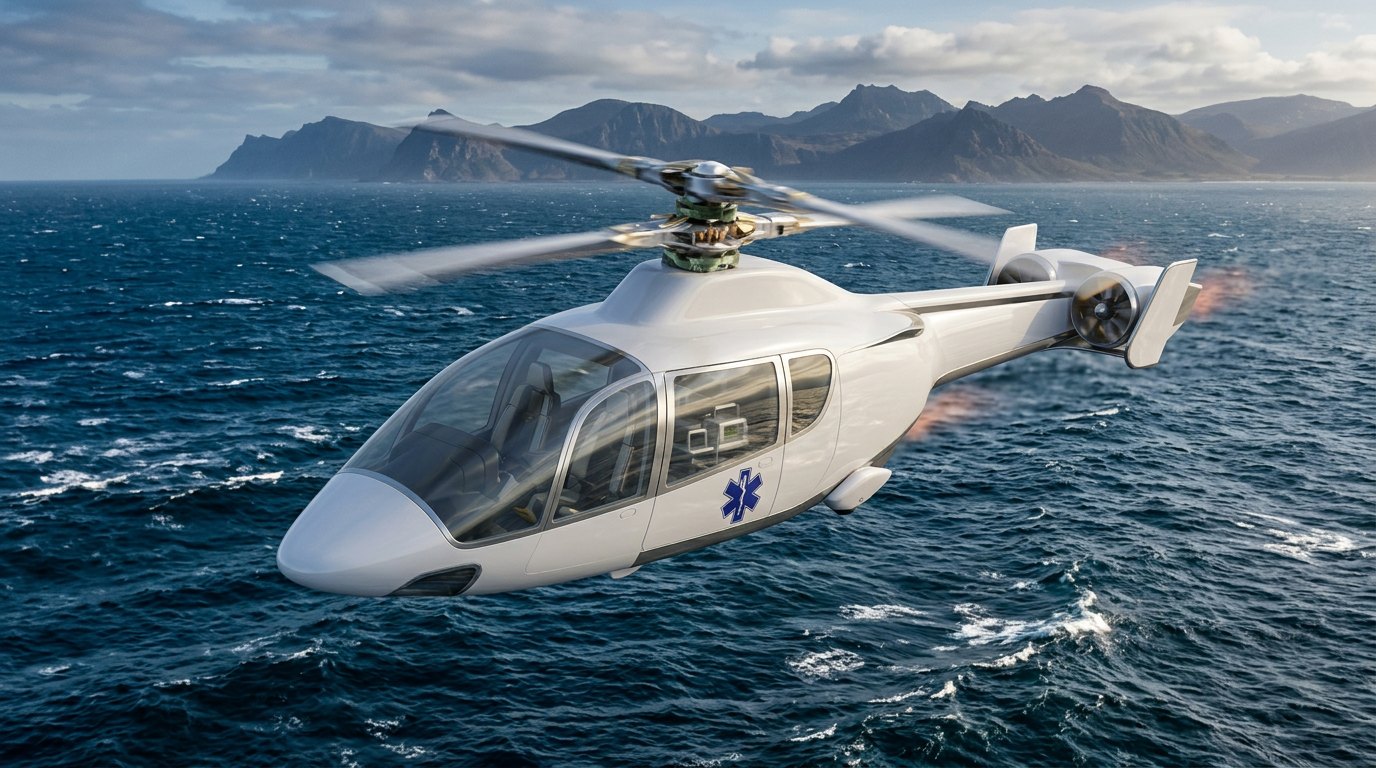
VTOL means vertical take-off and landing. Here is what a VTOL air ambulance is, how it reaches patients conventional aircraft cannot, and how hybrid VTOL differs from eVTOL and helicopters.
Key takeaways
- VTOL stands for vertical take-off and landing, no runway required.
- VTOL access lets an air ambulance reach rooftops, roadsides and mountainous terrain.
- Hybrid gyroplane VTOL differs from both helicopters and battery eVTOL aircraft.
- For aeromedical work, VTOL access directly shortens the time to definitive care.
“VTOL” is one of those aviation acronyms that turns up everywhere without ever being explained. For an air ambulance it is not jargon, it is the whole point. This guide explains what VTOL means, why it is essential to emergency aeromedical flight, and how different kinds of VTOL aircraft compare.
What VTOL means
VTOL stands for Vertical Take-Off and Landing. A VTOL aircraft can rise straight up off the ground and descend straight down, without the runway that a conventional aeroplane needs to build up speed. That single capability is what lets an aircraft operate from a hospital rooftop, a motorway hard shoulder, a field or a mountain ledge.
The opposite is CTOL, conventional take-off and landing, which describes fixed-wing aircraft that need a runway. There is also STOL (short take-off and landing) for aircraft that need only a small strip.
Why VTOL is essential for an air ambulance
Emergencies do not happen next to airports. A patient in cardiac arrest at a rural roadside, a climber injured on a ridge, or a casualty on the top floor of a city hospital all need an aircraft that can come directly to them. VTOL turns “where is the nearest runway?” into “where is the patient?”, and in emergency medicine, that difference is measured in survival.
Fixed-wing air ambulances remain vital for long-distance inter-hospital transfers, but they depend on airports at both ends and a road ambulance to bridge the gap. A VTOL air ambulance removes those bridges for the acute, time-critical mission.
The three kinds of VTOL air ambulance
1. The conventional helicopter
Helicopters are the original VTOL aircraft and still the backbone of HEMS. Their powered rotor provides excellent vertical access, but it comes with a tail rotor, the risk of vortex ring state, high fuel burn and high cost, the very issues driving the search for alternatives.
2. The battery eVTOL
Electric VTOL (eVTOL) aircraft, the “air taxi” concept, use multiple electric rotors. They are quiet and clean, but current battery energy density limits their range and payload, and their ability to carry a full critical-care cabin over useful distances is still maturing. They are a promising future option rather than a present-day workhorse for acute aeromedical missions.
3. The hybrid gyroplane-helicopter
A hybrid such as the Avectra 101 uses a powered rotor for vertical take-off and landing, then autorotates as a gyroplane in cruise. It keeps the helicopter's vertical access while gaining gyroplane-mode safety and efficiency, and, unlike battery eVTOL, it delivers full range and payload today. For a fuller comparison, see our explainer on gyroplane versus helicopter.
VTOL and the golden hour
Trauma and many medical emergencies are governed by time-critical windows, the so-called golden hour, and much shorter windows for conditions such as cardiac arrest and major haemorrhage. VTOL access shortens two parts of that clock at once: it reaches the scene faster, and it can land close enough to deliver the patient directly to definitive care rather than via a series of transfers.
VTOL is not about convenience. In aeromedical flight it is a clinical capability, time saved is outcome improved.
The takeaway
A VTOL air ambulance is simply one that can go straight to the patient and straight to the hospital, with no runway in between. Helicopters proved the concept; hybrid gyroplane-helicopters are refining it into something safer and more affordable; and eVTOL may extend it further in time. For the acute emergency mission today, VTOL access remains the single most important thing an air ambulance can offer.